


The idea started in the late 1950s when the Central Intelligence Agency (CIA) was looking for a way to overcome the range limitations of the U-2. Possessing a useful range of about 3,000 miles (4,800 km), the U-2 simply could not reach every location of interest to the CIA given the locations of U-2 bases. As a result, the CIA began a cooperative effort with the US Navy known as Project Whale Tale. The purpose of this project was to adapt the U-2 for use aboard aircraft carriers. Testing commenced in August of 1963 when, in the dark of night, a crane lifted a U-2C onto the deck of the USS Kitty Hawk at San Diego, California. The vessel streamed off the coast on the morning of 5 August where Lockheed test pilot Bob Schumacher began flight test operations.
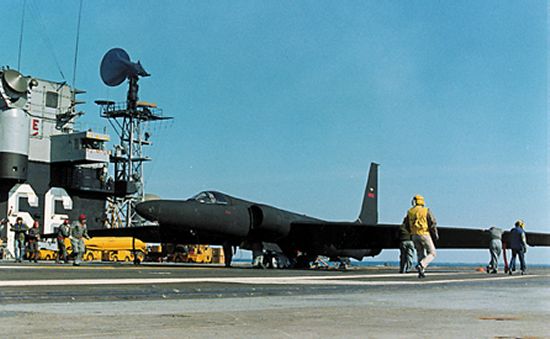
View of a U-2R aboard the USS America in 1969
Given the U-2's large wingspan and slow liftoff speed, takeoff was accomplished relatively easily. Even fully loaded, the U-2 managed to takeoff in only 321 ft (98 m) without use of the ship's catapults. Schumacher also successfully completed several landing approaches proving that the U-2's slow approach speed and high excess power provided plenty of margin for error in case of a waveoff. Unfortunately, actually landing proved more difficult when one wingtip struck the deck and the aircraft just barely managed to become airborne again before falling over the side.
Since this initial testing looked promising, Lockheed and the Navy modified three U-2A airframes with stronger landing gear, an arresting hook, and wing spoilers to decrease the lift during landing. These new aircraft became known as the U-2G. Schumacher and several CIA pilots also became carrier-qualified by flying the T-2 Buckeye trainer and making practice landings aboard the USS Lexington. All was ready on 2 March 1964 when Schumacher made the first landing of a U-2G aboard the USS Ranger off the California coast. Although a series of touch-and-go approaches had gone well, the first landing was slightly less than successful when the arrestor hook engaged and forced the nose of the plane to dig into the deck. Despite breaking off the pitot tube, quick repairs allowed the aircraft to takeoff again. Successful takeoffs and landings continued a few days later, and the Navy considered five CIA pilots to be qualified to operate the U-2 aboard ship.
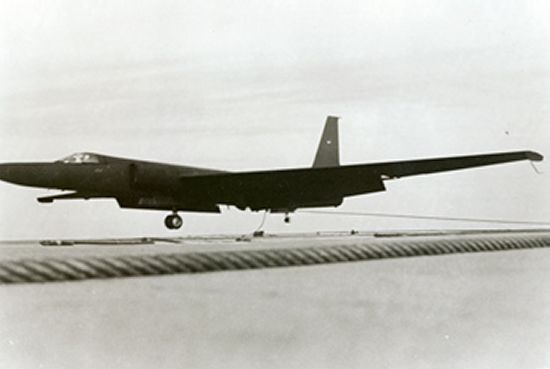
U-2R with arrestor hook deployed landing aboard the USS America
The first, and probably only, operational mission of the U-2G occurred in May 1964 when a plane operating off the USS Ranger monitored French nuclear tests at the Mururoa atoll. Otherwise, the capability to operate U-2s at sea did not appear to be in great demand. However, CIA pilots continued to be trained for carrier operations over the next few years.
In addition, the program continued when the much larger U-2R was introduced in 1967. Even being some 40% bigger than the U-2A or U-2G and with twice the range as well as four times the payload, the CIA and Navy still saw advantages to operating the aircraft from a carrier. Modifications included adding an arrestor hook and a wing-folding mechanism to fold the outer six feet of each wing for improved handling aboard ship.
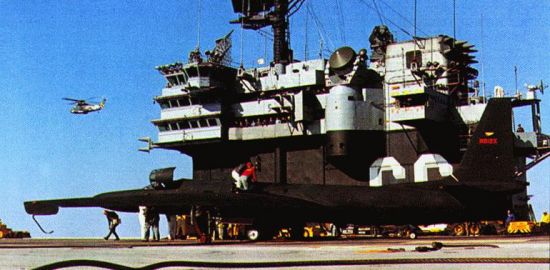
U-2R aboard the USS America
Sea trials took place from 21 to 23 November 1969 aboard USS America off the Virginia coast. The tests were conducted by Lockheed test pilot Bill Park plus four CIA pilots. After undergoing abbreviated carrier training, the pilots began a series of takeoffs and landings that proved completely successful. The aircraft was even transported down the ship's elevator to the hangar deck with no significant difficulties. Even after all this effort, however, the U-2R is not believed to ever have operated from a carrier again.
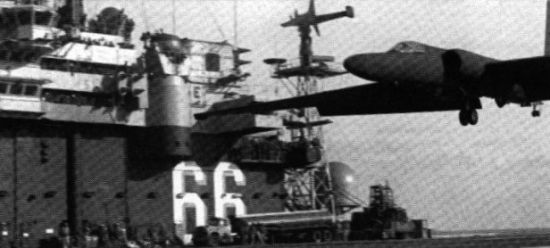
U-2R making a test landing approach
While Lockheed and the Navy continued evaluating naval derivatives of the U-2 for several years, no such aircraft ever entered service. From 1973-1974, two U-2R airframes were modified with a forward-looking radar and infrared detection system for use in the ocean surveillance role. These U-2EPX aircraft were to downlink radar data to surface ships to be melded with information from other land- and space-based sensors. However, the project was deemed too expensive and unnecessary given the evolution of satellites. Yet another proposal was a two-seat U-2 variant armed with the Condor anti-ship missile, an idea that quickly died following the cancellation of Condor.
C-130 Aircraft Carrier Operations
While a healthy skepticism of Marines is always a wise precaution, your fellow shop workers are indeed correct, this time. Not only did the C-130 land on and take off from an aircraft carrier, but what is even more amazing is that the plane did so unassisted--without using arresting gear to reduce the landing roll or becoming airborne with the aid of the ship's catapult.
The astounding feats occurrred from the deck of the USS Forrestal in October 1963 using a Marine Corps KC-130F. The motivation for these tests, ordered by the Chief of Naval Operations, was to determine the feasibility of using the existing C-130 aircraft as a long-range carrier onboard delivery (COD) transport. At the time, the Navy was using the C-1 Trader for COD duties, but the plane was limited to a rather small payload and a 300 mile (480 km) range. When operating far out at sea, carriers were unable to receive desperately needed supplies without steaming closer in to shore. It was hoped that the larger, long-range C-130 would be able to address that deficiency.
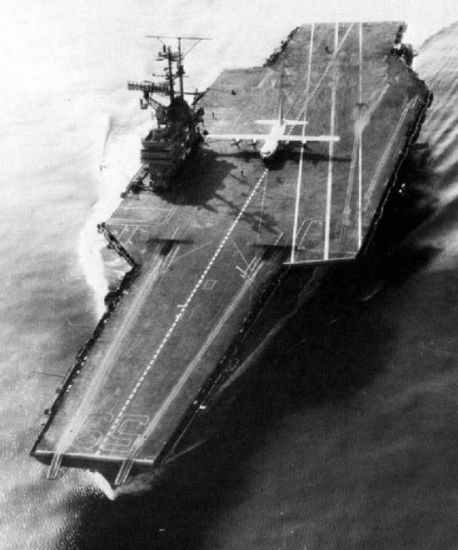
KC-130F on the deck of the USS Forrestal
And so it was, on 8 October, that the Navy received the KC-130F refueling tanker (BuNo 149798) on loan from the USMC. Prior to the tests, Lockheed had modified the plane by installing an anti-skid braking system, removing the underwing refueling pods, and adding a smaller nose gear orifice. The aircraft carried a crew of four: LT James Flatley as pilot, LCDR W. "Smokey" Stovall as copilot, ADR1 Ed Brennan as flight engineer, and Lockheed test pilot Ted Limmer. Another crewman participating in the tests was Al Sieve who's involvement went unrecognized until he recieved a medal in July 2004. Sieve was a chief petty officer who served as crew chief to insure that cargo was properly loaded for safe operations from the carrier deck. Some sources also indicate that Sieve was a flight engineer who replaced Ed Brennan on certain test flights.
Initial flight testing began on 30 October when the C-130 made its first landing on the Forrestal into a 40-knot wind. Helping to guide the C-130 along the deck was a special dashed centerline, visible in the above image. Even with this line, however, the aircraft's wingtip cleared the carrier's island control tower by less than 15 ft (4.6 m).
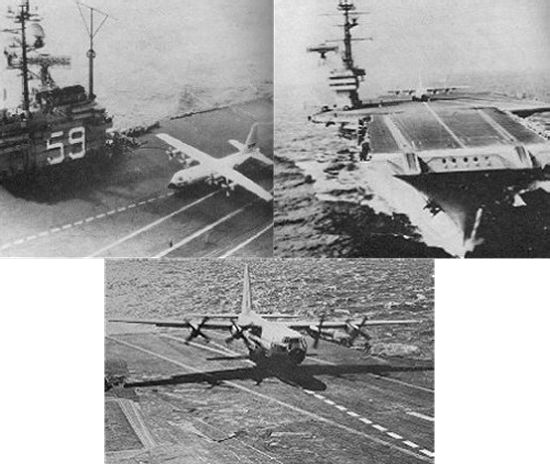
Several views of the C-130 operating at sea
Adding to the challenge of operating the large aircraft from a carrier deck was a relatively heavy sea state. In the words of Lockheed's chief engineer, Art Flock, who was aboard to observe the tests, "The sea was pretty big that day. I was up on the captain's bridge. I watched a man on the ship's bow as that bow must have gone up and down 30 feet." To ease the operations, the ship increased speed to provide more wind speed over the deck and reduce the unsteady rocking and heaving motions. "That airplane stopped right opposite the captain's bridge," recalled Flock. "There was cheering and laughing. There on the side of the fuselage, a big sign had been painted on that said LOOK MA, NO HOOK."
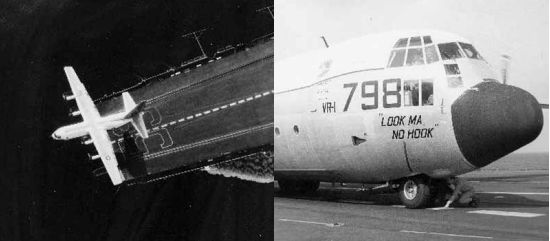
Views of the KC-130 operating from the Forrestal
Perhaps one of the most amazing accomplishments of the plane was described by Lockheed pilot Ted Limmer, who had qualified test pilot LT Flatley to fly the C-130. "The last landing I participated in, we touched down about 150 feet from the end, stopped in 270 feet more and launched from that position, using what was left of the deck. We still had a couple hundred feet left when we lifted off. Admiral Brown was flabbergasted." LT Flatley was eventually awarded the Distinguished Flying Cross by the Navy for his participation in the test program. Stovall, Brennan, and Sieve each received Air Medals.
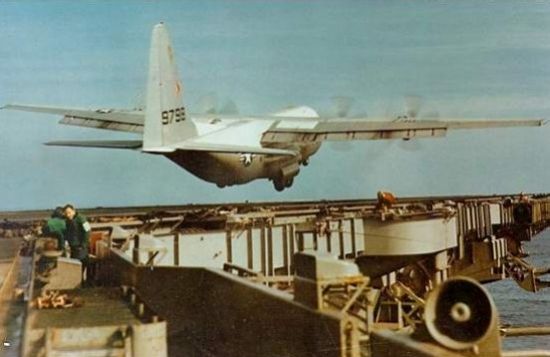
KC-130 taking off from the Forrestal
All told, the flight tests included 29 touch-and-go landings, 21 unarrested full-stop landings, and 21 unassisted takeoffs at gross weights ranging from 85,000 lb (38,555 kg) to 121,000 lb (54,885 kg). At the lower weight, the aircraft managed to come to a complete stop in only 267 ft (81 m), which is little more than double the plane's wingspan. Even at maximum weight, the C-130 required only 745 ft (227 m) for takeoff and 460 ft (140 m) for landing. Landings were made shorter by reversing the propellers while the aircraft was still a few feet above the flight deck. Videos documenting the landing and takeoff attempts are available on-line.
Based on these tests, it was determined that the C-130 could carry 25,000 lb (11,340 kg) of cargo and personnel to a carrier at a range of 2,500 miles (4,020 km). However, the risks of operating such a large aircraft in the hectic day-to-day carrier environment were considered too great, and the idea of using the C-130 as a COD aicraft was abandoned. The C-130 has never been operated from a carrier since, and the much smaller C-2A Greyhound was later selected to fulfill the COD role.
sm


 thanks Stevieboy - i did look briefly, but couldn't find any footage!


