whilst it's easy to think that the VC10 is merely a commercial airliner, there is much more to the story than that! originally conceived as a result of the aborted V1,000 (an RAF strategic transport) which Vickers hoped to later market as the VC7 commercial airliner (hence the "VC" - Vickers Commercial), the RAF, along with BOAC, were the launch customers so VC10 fits very neatly into both commercial AND military categories!
nearly 50 years after the elegant VC10 took to the air, the remaining few are operated solely by the RAF at Brize Norton. the RAF have operated 4 very different 'types' of VC10, two of which are basically the Standard model (shorter fuselage) and the other 2 'types' being Supers (longer fuselage). all started life in very different ways to each other with different roles and as a result, not all components are interchangeable between types.
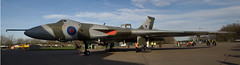
this photo shows all four types in one shot and was taken at Brize Norton only a few years ago on the very last day of operation of the K2.

they all look very similar i know, but they are all very different! nearest the camera is a K2, then K3, K4 and lastly C1K. all are AAR tankers (the 'K' in the name!)
so here's a pictorial history of the 4 different types.
C1K (majority still in service)
Built to RAF spec (a hybrid based on the Standard VC10) and originally for the transportation or personnel and/or palletised cargo. all have now been converted to tankers, without additional fuel tanks, and can still carry personnel/cargo if need be. all carry the names of recipients of the VC.
XV102 ("Guy Gibson") in the 'Lightning Strike' livery worn as delivered in the mid 1960s (the wing-pods are a 1990s modification for AAR)

XV102 as she is today

K2 (all scrapped)
in the early 1980s five civvy Standard VC10s were bought from Gulf Air and converted into dedicated tankers (no transport capability) and were to replace the Victor tankers still in service. extra fuel tanks were installed inside the cabin by means of cutting a hole in the top of the fuselage. this obviously affected their airframe strength and shortened their proposed lifespan. without these extra tanks, their fuel capacity was inadequate for their new role as a tanker.
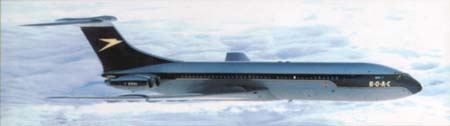
Standard VC10 as delivered to BOAC in the mid 1960s

Standard VC10 G-ARVL sold by BOAC to Gulf Air in the 1970s

G-ARVL again but bought by RAF and converted into K2

K3 (all still in service)
all four Super VC10 civvy airliners built for East African Airways. after EAA went bankrupt, they were repossessed by BAC/BAe and converted into K3 dedicated tankers (no transport capability). as with K2, extra fuel tanks were installed, but this time trough the cargo door which was part of the original EAA spec in the 1960s. these were the last VC10s to be built, have done the least hours and will be the last in RAF service. they have the greatest fuel capacity of the entire fleet (being Supers and with extra tanks). they are the mainstay of Britain's AAR capability.
Super VC10 '5H-MOG' as delivered to EAA in the mid/late 1960s

K3 conversion in progress (ex Gulf Air K2s in background)

5H-MOG as she is today (ZA150)

K4 (one in service)
in the early 1980s, British Airways sold ALL of their Super VC10s to the RAF. most were flown to RAF Abingdon to be put into long term storage. a handful went to Prestwick in Scotland. here they remained until the early 1990s when 5 were chosen to be converted into dedicated tankers - K4. all the airframes had deteriorated more than had been hoped and it was decided that the fitting of extra tanks inside (as with K2 and K3) would be too harmful to the airframe; none of these VC10s had cargo doors, so cutting a hole in the fuselage would've been the only means of installing them. as they were all Super VC10 with greater fuel capacity, it was deemed unnecessary - unlike the K2 some years before.
these 5 aircraft were ferry-flown to Filton for conversion (pictures below)
the remaining airframes were 'reduced to spares' and many of the fuselages used as instructional airframes.
Super VC10 G-ASGM as delivered to BOAC in the late 1960s

G-ASGM in BA colours shortly before 'retirement' and on to RAF hands

ex-BOAC/BA Super VC10s in storage

to preserve the airframes, Driclad bags were used initially

but they didn't last for long before being shredded by wind and rain, so a sealant was used instead - which attracted the dirt over the years!

after many years in open storage,and with only the barest minimum of systems operable, the (soon to be) K4s were ferry-flown to Filton for conversion - a 20 minute flight

K4 midway through conversion

G-ASGM as a K4 RAF tanker (ZD241) - the sole flying ex-BOAC/BA Super VC10

VC10 K4 ZD242 made her last ever flight to Boscombe Down at the end of August 2008. In a break from previous retirements this particular VC10 will not be 'spares recovered' and scrapped, at least not yet. Over a period of several months she will be used in a variety of tests to determine the effects of her long service life on the structure and systems. This will be used to look closely at the effects of ageing aircraft and to see what can be expected for the rest of the VC10 fleet until their planned out of service date (which will be in 2014). The data may also be useful for C130 and Tristar support programs.
sm