

- Board index
- Register
- Forum
- Information
- FAQ
- Rules
- The team
- Who is online
- Tools
- Delete all board cookies

- Login

Iconic Aircraft Aviation Forum
For the Appreciation of the World's Finest Aeroplanes
Aviation Orientated Countdown...
Re: Aviation Orientated Countdown...
 by Wedgy » Fri Mar 27, 2009 9:13 am
Advert first published in 1933

-

Wedgy - Site Admin

- Posts: 7051
- Joined: Mon Sep 29, 2008 2:09 pm
- Location: Wiltshire
- Also Known As: Wedginald
Re: Aviation Orientated Countdown...
by Mayfly » Fri Mar 27, 2009 9:28 am
Thought provoking sad report from 32 years ago today
27 March
The world's greatest air tragedy occurs when two Boeing 747's collide on the runway at Santa Cruz Airport in Tenerife, killing 579 people.
27 March
The world's greatest air tragedy occurs when two Boeing 747's collide on the runway at Santa Cruz Airport in Tenerife, killing 579 people.
In memory of a very dear friend - Mike Pearson
Very fond memories of Robbie Gilvary - DTs 1st Vulcan Captain who taught DT all he knew.
Very fond memories of Robbie Gilvary - DTs 1st Vulcan Captain who taught DT all he knew.
-

Mayfly - Moderator

- Posts: 29760
- Joined: Mon Sep 29, 2008 7:11 pm
- Location: Bomber County
Re: Aviation Orientated Countdown...
by Mackrick » Fri Mar 27, 2009 7:23 pm
1931- The "Ultimate Biplane Fighter". The Hawker Fury, takes to the air for the first time. It went on to serve with three frontline squadrons until 1939.

Duc, sequere, aut de via decede
-

Mackrick - Moderator
- Posts: 9429
- Joined: Mon Oct 13, 2008 7:36 pm
- Location: Doncaster South Yorkshire
Re: Aviation Orientated Countdown...
by Saracenman » Fri Mar 27, 2009 7:58 pm
30mm - the calibre of the ADEN cannon...

The ADEN (named for the Armament Development Establishment, where it was designed, and Enfield, where it is produced) was developed in the late 1940s as a replacement for the older Hispano-Suiza HS.404 20 mm cannon used in British aircraft of World War II. It is based (as are the French DEFA cannon and American M39 cannon) on the mechanism of the German Mauser MG 213C, an experimental revolver cannon designed for the Luftwaffe, but never used in combat. The ADEN entered service on the Hawker Hunter in 1954, and subsequently used on every British gun-armed aircraft until the advent of the Panavia Tornado in the 1980s.
The current version is the ADEN Mk 4. Although its muzzle velocity of 2,430 ft/s (741 m/s) is considerably lower than the Hispano's 2,789 ft/s (850 m/s), the substantially heavier projectile makes the ADEN more lethal, and it has a higher rate of fire of about 1,300 rounds per minute.
An improved version, the ADEN Mk 5, incorporates a multitude of small changes to improve reliability and increase rate of fire slightly to 1,500–1,700 rounds per minute. No new Mk 5s were built, but many older weapons were converted, being redesignated Mk 5 Straden.
Aircraft using the ADEN 30 as in-built armament have included the A-4SU Super Skyhawk, English Electric Lightning, Folland Gnat (and HAL Ajeet), Hawker Hunter, Gloster Javelin, Saab Lansen, Saab Draken, SEPECAT Jaguar, Supermarine Scimitar, and CAC Sabre. Several podded versions exist, including the installations scabbed below the fuselage of British Hawker Siddeley Harrier (and USMC AV-8A/Cs) and Sea Harriers and the Swedish FFV Aden, which is used (among others) on the BAe Hawk. The FFV Aden contains the weapon and 150 rounds of ammunition, is 151.57 in (3.85 m) long, and weighs 802.5 lb (364 kg) fully loaded.
The ADEN is very similar to the French DEFA cannon, and the two weapons use the same range of 30 mm ammunition.
sm
The ADEN (named for the Armament Development Establishment, where it was designed, and Enfield, where it is produced) was developed in the late 1940s as a replacement for the older Hispano-Suiza HS.404 20 mm cannon used in British aircraft of World War II. It is based (as are the French DEFA cannon and American M39 cannon) on the mechanism of the German Mauser MG 213C, an experimental revolver cannon designed for the Luftwaffe, but never used in combat. The ADEN entered service on the Hawker Hunter in 1954, and subsequently used on every British gun-armed aircraft until the advent of the Panavia Tornado in the 1980s.
The current version is the ADEN Mk 4. Although its muzzle velocity of 2,430 ft/s (741 m/s) is considerably lower than the Hispano's 2,789 ft/s (850 m/s), the substantially heavier projectile makes the ADEN more lethal, and it has a higher rate of fire of about 1,300 rounds per minute.
An improved version, the ADEN Mk 5, incorporates a multitude of small changes to improve reliability and increase rate of fire slightly to 1,500–1,700 rounds per minute. No new Mk 5s were built, but many older weapons were converted, being redesignated Mk 5 Straden.
Aircraft using the ADEN 30 as in-built armament have included the A-4SU Super Skyhawk, English Electric Lightning, Folland Gnat (and HAL Ajeet), Hawker Hunter, Gloster Javelin, Saab Lansen, Saab Draken, SEPECAT Jaguar, Supermarine Scimitar, and CAC Sabre. Several podded versions exist, including the installations scabbed below the fuselage of British Hawker Siddeley Harrier (and USMC AV-8A/Cs) and Sea Harriers and the Swedish FFV Aden, which is used (among others) on the BAe Hawk. The FFV Aden contains the weapon and 150 rounds of ammunition, is 151.57 in (3.85 m) long, and weighs 802.5 lb (364 kg) fully loaded.
The ADEN is very similar to the French DEFA cannon, and the two weapons use the same range of 30 mm ammunition.
sm
Lunchtime! 

-

Saracenman - Boeing B-52 Stratofortress

- Posts: 12047
- Joined: Mon Sep 29, 2008 2:17 pm
- Location: Away from Cats
- Also Known As: Nobody
Re: Aviation Orientated Countdown...
by Mayfly » Fri Mar 27, 2009 8:03 pm
My first job in the RAF was servicing them & the hunter gun packs 
Last edited by Mayfly on Fri Mar 27, 2009 9:49 pm, edited 1 time in total.
In memory of a very dear friend - Mike Pearson
Very fond memories of Robbie Gilvary - DTs 1st Vulcan Captain who taught DT all he knew.
Very fond memories of Robbie Gilvary - DTs 1st Vulcan Captain who taught DT all he knew.
-
Mayfly - Moderator
- Posts: 29760
- Joined: Mon Sep 29, 2008 7:11 pm
- Location: Bomber County
Re: Aviation Orientated Countdown...
by Mackrick » Fri Mar 27, 2009 8:39 pm
Boeing submitted the prototype for the B-29 long-range heavy bomber to the Army in 1939, before the United States entered World War II.
The B-29 had many new features, including guns that could be fired by remote control. The crew areas were pressurized and connected by a long tube over the bomb bays. The tail gunner had a separate pressurized area that could only be left during unpressurized flight. The B-29 was also the heaviest production plane because of increases in range, bomb load and defensive requirements.
The B-29 used the high-speed Boeing 117 airfoil, and its larger Fowler flaps added to the wing area as they increased lift. Modifications led to the B-29D, upgraded to the B-50, and the RB-29 photo reconnaissance aircraft. The Soviet-built copy of the B-29 was called the Tupolev Tu-4.
The earliest B-29s were built before testing was finished, so the Army established modification centers where last-minute changes could be made without slowing expanding assembly lines
Boeing built a total of 2,766 B-29s at plants in Wichita, Kan., (previously the Stearman Aircraft Co., bought by Boeing in 1929) and in Renton, Wash. The Bell Aircraft Co. built 668 of the giant bombers in Georgia, and the Glenn L. Martin Co. built 536 in Nebraska. Production ended in 1946.
B-29s were primarily used in the Pacific theater during World War II. As many as 1,000 Superfortresses at a time bombed Tokyo, destroying large parts of the city. Finally, on Aug. 6, 1945, the B-29 Enola Gay dropped the world's first atomic bomb on Hiroshima, Japan. Three days later a second B-29, Bockscar, dropped another atomic bomb on Nagasaki. Shortly thereafter, Japan surrendered.
After the war, B-29s were adapted for several functions, including in-flight refueling, anti-submarine patrol, weather reconnaissance and rescue duty. The B-29 saw military service again in Korea between 1950 and 1953, battling new adversaries: jet fighters and electronic weapons. The last B-29 in squadron use retired from service in September 1960.
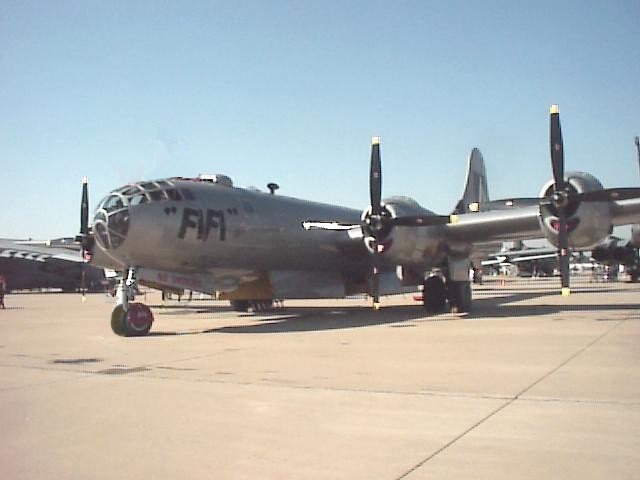

The B-29 had many new features, including guns that could be fired by remote control. The crew areas were pressurized and connected by a long tube over the bomb bays. The tail gunner had a separate pressurized area that could only be left during unpressurized flight. The B-29 was also the heaviest production plane because of increases in range, bomb load and defensive requirements.
The B-29 used the high-speed Boeing 117 airfoil, and its larger Fowler flaps added to the wing area as they increased lift. Modifications led to the B-29D, upgraded to the B-50, and the RB-29 photo reconnaissance aircraft. The Soviet-built copy of the B-29 was called the Tupolev Tu-4.
The earliest B-29s were built before testing was finished, so the Army established modification centers where last-minute changes could be made without slowing expanding assembly lines
Boeing built a total of 2,766 B-29s at plants in Wichita, Kan., (previously the Stearman Aircraft Co., bought by Boeing in 1929) and in Renton, Wash. The Bell Aircraft Co. built 668 of the giant bombers in Georgia, and the Glenn L. Martin Co. built 536 in Nebraska. Production ended in 1946.
B-29s were primarily used in the Pacific theater during World War II. As many as 1,000 Superfortresses at a time bombed Tokyo, destroying large parts of the city. Finally, on Aug. 6, 1945, the B-29 Enola Gay dropped the world's first atomic bomb on Hiroshima, Japan. Three days later a second B-29, Bockscar, dropped another atomic bomb on Nagasaki. Shortly thereafter, Japan surrendered.
After the war, B-29s were adapted for several functions, including in-flight refueling, anti-submarine patrol, weather reconnaissance and rescue duty. The B-29 saw military service again in Korea between 1950 and 1953, battling new adversaries: jet fighters and electronic weapons. The last B-29 in squadron use retired from service in September 1960.
Duc, sequere, aut de via decede
-
Mackrick - Moderator
- Posts: 9429
- Joined: Mon Oct 13, 2008 7:36 pm
- Location: Doncaster South Yorkshire
Re: Aviation Orientated Countdown...
by Jigsaw » Fri Mar 27, 2009 9:43 pm
arrrgggghhhhh its horrible

Oh yeah...its a MI-28 (Havoc) armed to the teeth (well it is a dog) http://www.metacafe.com/watch/114752/mi_28/
Oh yeah...its a MI-28 (Havoc) armed to the teeth (well it is a dog) http://www.metacafe.com/watch/114752/mi_28/
Last edited by Jigsaw on Fri Mar 27, 2009 9:56 pm, edited 2 times in total.
Kev
-

Jigsaw - Boeing 747

- Posts: 6456
- Joined: Thu Feb 05, 2009 1:58 pm
- Location: Scunthorpe
- Also Known As: photo_lincs
Re: Aviation Orientated Countdown...
by Saracenman » Fri Mar 27, 2009 9:43 pm
yeah - gruesome 
Last edited by Saracenman on Fri Mar 27, 2009 9:52 pm, edited 1 time in total.
Lunchtime!
-
Saracenman - Boeing B-52 Stratofortress
- Posts: 12047
- Joined: Mon Sep 29, 2008 2:17 pm
- Location: Away from Cats
- Also Known As: Nobody
Re: Aviation Orientated Countdown...
by Jigsaw » Fri Mar 27, 2009 9:52 pm
SU-27

Strangely menacing methinks
Strangely menacing methinks
Kev
-
Jigsaw - Boeing 747
- Posts: 6456
- Joined: Thu Feb 05, 2009 1:58 pm
- Location: Scunthorpe
- Also Known As: photo_lincs
Re: Aviation Orientated Countdown...
by Mackrick » Fri Mar 27, 2009 10:00 pm
The Sukhoi Su-26 prototype first took flight in June, 1984 with test pilot Eugene Frolov at the controls. The Su-26 embodied a number of innovations that would revolutionize the air show and competition world, but high on the list was its composite-intensive construction. Its fuselage is built around a steel-tube truss and covered in a fiberglass shell, and its wings are built entirely of composite materials. This construction method lends itself well to light weight and a smooth finish, both principles that Russian designers usually shunned.

Duc, sequere, aut de via decede
-
Mackrick - Moderator
- Posts: 9429
- Joined: Mon Oct 13, 2008 7:36 pm
- Location: Doncaster South Yorkshire
Re: Aviation Orientated Countdown...
by Saracenman » Fri Mar 27, 2009 10:02 pm
25 - the score out of 10 for that Sukhoi pilot's testicle size! 
Lunchtime!
-
Saracenman - Boeing B-52 Stratofortress
- Posts: 12047
- Joined: Mon Sep 29, 2008 2:17 pm
- Location: Away from Cats
- Also Known As: Nobody
Re: Aviation Orientated Countdown...
by Jigsaw » Fri Mar 27, 2009 10:04 pm
25 Squadron
Aircraft
December 1938-January 1941: Bristol Blenheim IF
August-November 1939: Bristol Blenheim IVF
October 1940-January 1943: Bristol Beaufighter I
July 1941-September 1941: Havoc I
October 1942-February 1944: de Havilland Mosquito NF Mk II
September 1943-February 1945: de Havilland Mosquito FB Mk VI
December 1943-November 1944: de Havilland Mosquito XVII
December 1944-September 1946: de Havilland Mosquito FN Mk 30
Location
22 August-15 September 1939: Northholt
15 September-4 October 1939: Filton
4 October 1939-16 January 1940: Northolt
16 January-19 June 1940: North Weald
19 June-1 September 1940: Martlesham Heath
1 September-8 October 1940: North Weald
8 October-27 November 1940: Debden
27 November 1940-24 January 1942: Wittering
24 January-16 May 1942: Ballyhalbert
16 May 1942-19 December 1943: Church Fenton
19 December 1943-5 February 1944: Acklington
5 February-27 October 1944: Coltishall
26 October 1944-11 January 1946: Castle Camps
Aircraft
December 1938-January 1941: Bristol Blenheim IF
August-November 1939: Bristol Blenheim IVF
October 1940-January 1943: Bristol Beaufighter I
July 1941-September 1941: Havoc I
October 1942-February 1944: de Havilland Mosquito NF Mk II
September 1943-February 1945: de Havilland Mosquito FB Mk VI
December 1943-November 1944: de Havilland Mosquito XVII
December 1944-September 1946: de Havilland Mosquito FN Mk 30
Location
22 August-15 September 1939: Northholt
15 September-4 October 1939: Filton
4 October 1939-16 January 1940: Northolt
16 January-19 June 1940: North Weald
19 June-1 September 1940: Martlesham Heath
1 September-8 October 1940: North Weald
8 October-27 November 1940: Debden
27 November 1940-24 January 1942: Wittering
24 January-16 May 1942: Ballyhalbert
16 May 1942-19 December 1943: Church Fenton
19 December 1943-5 February 1944: Acklington
5 February-27 October 1944: Coltishall
26 October 1944-11 January 1946: Castle Camps
Kev
-
Jigsaw - Boeing 747
- Posts: 6456
- Joined: Thu Feb 05, 2009 1:58 pm
- Location: Scunthorpe
- Also Known As: photo_lincs
Re: Aviation Orientated Countdown...
by Spitfire » Fri Mar 27, 2009 11:25 pm
Consolidated B24 Liberator

The Consolidated B-24 Liberator was an American heavy bomber, built by Consolidated Aircraft. It was produced in greater numbers than any other American combat aircraft of World War II and still holds the record as the most produced U.S. military aircraft. It was used by many Allied air forces and every U.S. branch of service during the war, attaining a distinguished war record with its operations in the northern European, Pacific and Mediterranean theaters.
The Consolidated B-24 Liberator was an American heavy bomber, built by Consolidated Aircraft. It was produced in greater numbers than any other American combat aircraft of World War II and still holds the record as the most produced U.S. military aircraft. It was used by many Allied air forces and every U.S. branch of service during the war, attaining a distinguished war record with its operations in the northern European, Pacific and Mediterranean theaters.
David
http://ultimatewarbirdflights.com/
Get 'NX611' back in the air http://www.lincsaviation.co.uk/news/lancaster-nx611-return-to-flight/
http://ultimatewarbirdflights.com/
Get 'NX611' back in the air http://www.lincsaviation.co.uk/news/lancaster-nx611-return-to-flight/
-

Spitfire - Boeing 747
- Posts: 5207
- Joined: Wed Dec 10, 2008 11:06 am
- Location: Hayle, SW Cornwall
Re: Aviation Orientated Countdown...
by Saracenman » Fri Mar 27, 2009 11:37 pm
the most widely produced?  blimey I'm so glad i started this thread now - it's been enlightening!
blimey I'm so glad i started this thread now - it's been enlightening! Lunchtime!
-
Saracenman - Boeing B-52 Stratofortress
- Posts: 12047
- Joined: Mon Sep 29, 2008 2:17 pm
- Location: Away from Cats
- Also Known As: Nobody
Re: Aviation Orientated Countdown...
by Spitfire » Sat Mar 28, 2009 12:16 am
No this is en-lightning ..... Lockheed P38 Lightning - '23 Skidoo'


David
http://ultimatewarbirdflights.com/
Get 'NX611' back in the air http://www.lincsaviation.co.uk/news/lancaster-nx611-return-to-flight/
http://ultimatewarbirdflights.com/
Get 'NX611' back in the air http://www.lincsaviation.co.uk/news/lancaster-nx611-return-to-flight/
-
Spitfire - Boeing 747
- Posts: 5207
- Joined: Wed Dec 10, 2008 11:06 am
- Location: Hayle, SW Cornwall
Re: Aviation Orientated Countdown...
by Wedgy » Sat Mar 28, 2009 10:26 am
The V-22 Osprey is a multi-mission, military tiltrotor aircraft with both a vertical takeoff and landing (VTOL) and short takeoff and landing (STOL) capability. It is designed to perform missions like a conventional helicopter with the long-range, high-speed cruise performance of a turboprop aircraft. The V-22 was developed by Bell Helicopter, which manufactures it in partnership with Boeing Rotorcraft Systems. The initial operators are the United States Marine Corps and Air Force. The FAA classifies the Osprey as a model of powered lift aircraft.

-
Wedgy - Site Admin
- Posts: 7051
- Joined: Mon Sep 29, 2008 2:09 pm
- Location: Wiltshire
- Also Known As: Wedginald
Re: Aviation Orientated Countdown...
by Spitfire » Sat Mar 28, 2009 11:14 pm
Mikoyan-Gurevich MiG 21PF

Serial Number: 7105
Period: Post-WWII
Collection Ref: X003-6783
Location: RAF Museum Cosford, National Cold War Exhibition
The MiG-21 was the first Soviet fighter capable of flying faster than twice the speed of sound and is an iconic aircraft of the Cold War years. MiG-21s saw extensive combat action in such diverse conflicts as Vietnam, the Arab-Israeli Wars, the Iran-Iraq War, Afghanistan and Desert Storm.
This aircraft is typical of the early 'First Generation' variants of the MiG-21 'Fishbed' which was first designed as a simple, lightweight jet fighter, first flown as a pre-production prototype in 1957.
Following on from the initial MiG21F 'Fishbed-C' production variant, in 1960 the new MiG-21P variant (NATO reporting name 'Fishbed-D') dispensed with the original internal cannon armament completely in favour of air-air missiles or rocket pods and introduced a modified fuselage with a longer nose, and modified canopy and spine with a distinctive bulge immediately aft of the cockpit. This was followed in production from 1962 to 1964 by the MiG21PF, as seen here, with uprated afterburning engine and the pitot probe relocated to the top of the nose. This variant also introduced a new system for controlling the variable intake centrebody at the nose, whose larger intake accommodated new RP-21 search/track radar, giving all-weather capability. The MiG-21 PFM for the Soviet Air Force was produced between 1964 and 1965, and the Mig-21 PFS version was produced for export from 1966-68.
Serial Number: 7105
Period: Post-WWII
Collection Ref: X003-6783
Location: RAF Museum Cosford, National Cold War Exhibition
The MiG-21 was the first Soviet fighter capable of flying faster than twice the speed of sound and is an iconic aircraft of the Cold War years. MiG-21s saw extensive combat action in such diverse conflicts as Vietnam, the Arab-Israeli Wars, the Iran-Iraq War, Afghanistan and Desert Storm.
This aircraft is typical of the early 'First Generation' variants of the MiG-21 'Fishbed' which was first designed as a simple, lightweight jet fighter, first flown as a pre-production prototype in 1957.
Following on from the initial MiG21F 'Fishbed-C' production variant, in 1960 the new MiG-21P variant (NATO reporting name 'Fishbed-D') dispensed with the original internal cannon armament completely in favour of air-air missiles or rocket pods and introduced a modified fuselage with a longer nose, and modified canopy and spine with a distinctive bulge immediately aft of the cockpit. This was followed in production from 1962 to 1964 by the MiG21PF, as seen here, with uprated afterburning engine and the pitot probe relocated to the top of the nose. This variant also introduced a new system for controlling the variable intake centrebody at the nose, whose larger intake accommodated new RP-21 search/track radar, giving all-weather capability. The MiG-21 PFM for the Soviet Air Force was produced between 1964 and 1965, and the Mig-21 PFS version was produced for export from 1966-68.
David
http://ultimatewarbirdflights.com/
Get 'NX611' back in the air http://www.lincsaviation.co.uk/news/lancaster-nx611-return-to-flight/
http://ultimatewarbirdflights.com/
Get 'NX611' back in the air http://www.lincsaviation.co.uk/news/lancaster-nx611-return-to-flight/
-
Spitfire - Boeing 747
- Posts: 5207
- Joined: Wed Dec 10, 2008 11:06 am
- Location: Hayle, SW Cornwall
Re: Aviation Orientated Countdown...
by Saracenman » Sun Mar 29, 2009 12:45 am
20 mm

The Hispano-Suiza HS.404 was an autocannon widely used as both an aircraft and land weapon in the 20th century by British, American, French and numerous other military services. Firing a 20 mm diameter projectile, it delivered a useful load of explosive from a relatively light weapon. This made it an ideal aircraft weapon, replacing the multiple 7.62 mm (.30 calibre) machine guns commonly used in military aircraft in the 1930s.
The HS.404 was based on the earlier Swiss Oerlikon FF S weapons, which Hispano-Suiza manufactured under license in France as HS.7 and HS.9. In the late 1930s engineer Marc Birkigt designed a new and much improved version with a revised action, much faster rate of fire, and somewhat higher muzzle velocity. The result was the Type 404, or HS.404, which was widely considered the best aircraft cannon of its kind. The 404 was widely used on pre-war French designs, notably in installations firing through the drive shaft of the Hispano-Suiza 12Y engine, a system known as a moteur-canon. The HS.404 was fed by drum magazines that could accommodate at most 60 rounds. Since in most installations the magazine could not be switched during flight, the small ammunition capacity was problematic. In 1940, Hispano-Suiza was developing a belt-feeding system, as well as derivatives of the HS.404 in heavier calibres such as 23 mm, but all these projects were halted with the German occupation of France.
In the meantime, Great Britain had acquired a license to build the HS.404, which entered production as the Hispano Mk.I. Its first used was with the Westland Whirlwind of 1940, providing the Royal Air Force with a powerful cannon-armed interceptor. It was also used in early versions of the Bristol Beaufighter. The Beaufighter highlighted the need for a belt feed mechanism; in the night fighter role the 60-round drums needed to be replaced in the dark by the Wireless Operator, often while the aircraft was manœuvring to keep sight of its quarry. In addition, early trial installations in the Hawker Hurricane and Supermarine Spitfire had shown a tendency for the gun to jam during combat manœuvres, leading to some official doubt as to the suitability of cannons as the sole main armament. This led, briefly, to the Air Ministry specifying 12-gun machine gun armament for its future fighters.
Subsequently a suitable belt-feeding system was developed by the Martin-Baker Aircraft Co. Ltd. and the new design was adopted by the RAF and FAA in 1941 in a slightly modified form as the Hispano Mk.II. Four cannons replaced the eight Browning .303 machine guns in the Hurricane and in tropical versions of the Spitfire, and became standard armament in later fighters. Most other Spitfires had only two cannons, because of technical difficulties (i.e., inadequate gun-heating capacity for the outboard cannon leading to the gun freezing at high altitudes), along with four 0.303 calibre or two 0.50 calibre machine guns.
The gun was also licensed for use in the United States as the M1, with both the United States Army Air Corps (USAAC) and U.S. Navy planning to switch to the 20 mm as soon as sufficient production was ready. A massive building program was set up, along with production of ammunition, in 1941. When delivered, the guns proved to be extremely unreliable and suffered a considerable number of misfires due to the round being "lightly struck" by the firing pin. The British were interested in using this weapon to ease production in England, but after receiving the M1 they were disappointed.
In April 1942 a copy of the British Mk.II was sent to the U.S. for comparison, the British version used a slightly shorter chamber and did not have the same problems as the U.S. version of the cannon. The U.S. declined to modify the chamber of their version, but nevertheless made other modifications to create the no-more-reliable M2. By late 1942 the USAAC had 40 million rounds of ammunition stored, but the guns remained unsuitable. The U.S. Navy had been trying to go all-cannon throughout the war, but the conversion never occurred. As late as December 1945 the Army's Chief of Ordnance was still attempting to complete additional changes to the design to allow it to enter service.
Meanwhile, the British had given up on the U.S. versions and production levels had been ramped up to the point where this was no longer an issue anyway. They upgraded to the Hispano Mk. V, which had a shorter barrel, was lighter and had a higher rate of fire, (desirable in aircraft armament) although at the expense of some muzzle velocity. One of the main British fighters to use the Mk. V was the Hawker Tempest Mk. V Series II, which mounted a total of four. The U.S. followed suit with the M3, but reliability problems continued. After World War II the United States Air Force (USAF) adopted a version of the M3 cannon as the M24, similar in most respects except for the use of electrically primed ammunition.
The Hispano fired a 130 gram (4.58 oz) 20 mm × 110 mm projectile with a muzzle velocity between 840 and 880 m/s (2,750 and 2,900 ft/s), depending on barrel length. Rate of fire was between 600 and 850 rounds per minute. It was 2.36 m (7 ft 9 in) long, weighing between 42 and 50 kg (93 and 110 lb). The British Mk V and American M3/M24 weapons were lighter with higher rates of fire than the early HS.404 guns.
In the post-war era the HS.404 disappeared fairly quickly due to the introduction of revolver cannon based on the German Mauser MG 213. The British introduced the powerful 30 mm ADEN cannon in most of their post-war designs, and the French used the very similar DEFA cannon, both firing the same ammunition. The USAF introduced the 20 mm M39 revolver cannon to replace the M24, while the Navy instead combined the original Hispano design with a lighter round for better muzzle velocity in the Colt Mk 12 cannon.
Usage
France
HS.404
- Bloch MB.152
- Breguet 693
- Dewoitine D.500
- Dewoitine D.520
- LeO 451
- Morane-Saulnier M.S.406
- Potez 631
United Kingdom & Commonwealth
Hispano Mk. I
- Gloster F.9/37 -a design not taken into service
- Westland Whirlwind - the RAF's first cannon armed fighter.
- Bristol Beaufighter - early aircraft
- Hispano Mk. II
- Blackburn Firebrand
- Blackburn Firecrest
- Bristol Beaufighter
- CAC Boomerang
- Consolidated Liberator GR I
- de Havilland Mosquito
- Douglas Boston III (Intruder)
- Fairey Firefly
- Gloster Meteor
- Hawker Hurricane Mk IIC
- Hawker Tempest Mk V Srs I
- Hawker Typhoon Mk IB
- North American Mustang IA
- Supermarine Spitfire Marks V to Mark 20
Hispano Mk. V
- Avro Shackleton
- Bristol Brigand
- de Havilland Hornet & Sea Hornet
- de Havilland Vampire
- de Havilland Venom & Sea Venom
- English Electric Canberra B.Mk.6 & B(I).Mk.8
- Hawker Fury & Sea Fury
- Hawker Sea Hawk
- Hawker Tempest Mk V Srs II and subsequent Marks
-Martin-Baker MB 5
- Supermarine Attacker
- Supermarine Seafang
- Supermarine Spiteful
- Supermarine Spitfire - Marks 21 and later
- Westland Welkin
-Westland Wyvern
United States
M2
- Bell P-400 (P-39 Airacobra diverted from export)
- Boeing B-29 Superfortress
- Lockheed P-38 Lightning
- Northrop P-61 Black Widow
- Chance Vought F4U-1C Corsair
M3
- Chance Vought F4U-4B Corsair and all following versions
- Chance Vought F6U Pirate
- Chance Vought F7U Cutlass
M24
- Convair B-36
- Northrop F-89C Scorpion
Yugoslavia
HS.404
- Ikarus IK-2
- Rogozarski IK-3
sm
The Hispano-Suiza HS.404 was an autocannon widely used as both an aircraft and land weapon in the 20th century by British, American, French and numerous other military services. Firing a 20 mm diameter projectile, it delivered a useful load of explosive from a relatively light weapon. This made it an ideal aircraft weapon, replacing the multiple 7.62 mm (.30 calibre) machine guns commonly used in military aircraft in the 1930s.
The HS.404 was based on the earlier Swiss Oerlikon FF S weapons, which Hispano-Suiza manufactured under license in France as HS.7 and HS.9. In the late 1930s engineer Marc Birkigt designed a new and much improved version with a revised action, much faster rate of fire, and somewhat higher muzzle velocity. The result was the Type 404, or HS.404, which was widely considered the best aircraft cannon of its kind. The 404 was widely used on pre-war French designs, notably in installations firing through the drive shaft of the Hispano-Suiza 12Y engine, a system known as a moteur-canon. The HS.404 was fed by drum magazines that could accommodate at most 60 rounds. Since in most installations the magazine could not be switched during flight, the small ammunition capacity was problematic. In 1940, Hispano-Suiza was developing a belt-feeding system, as well as derivatives of the HS.404 in heavier calibres such as 23 mm, but all these projects were halted with the German occupation of France.
In the meantime, Great Britain had acquired a license to build the HS.404, which entered production as the Hispano Mk.I. Its first used was with the Westland Whirlwind of 1940, providing the Royal Air Force with a powerful cannon-armed interceptor. It was also used in early versions of the Bristol Beaufighter. The Beaufighter highlighted the need for a belt feed mechanism; in the night fighter role the 60-round drums needed to be replaced in the dark by the Wireless Operator, often while the aircraft was manœuvring to keep sight of its quarry. In addition, early trial installations in the Hawker Hurricane and Supermarine Spitfire had shown a tendency for the gun to jam during combat manœuvres, leading to some official doubt as to the suitability of cannons as the sole main armament. This led, briefly, to the Air Ministry specifying 12-gun machine gun armament for its future fighters.
Subsequently a suitable belt-feeding system was developed by the Martin-Baker Aircraft Co. Ltd. and the new design was adopted by the RAF and FAA in 1941 in a slightly modified form as the Hispano Mk.II. Four cannons replaced the eight Browning .303 machine guns in the Hurricane and in tropical versions of the Spitfire, and became standard armament in later fighters. Most other Spitfires had only two cannons, because of technical difficulties (i.e., inadequate gun-heating capacity for the outboard cannon leading to the gun freezing at high altitudes), along with four 0.303 calibre or two 0.50 calibre machine guns.
The gun was also licensed for use in the United States as the M1, with both the United States Army Air Corps (USAAC) and U.S. Navy planning to switch to the 20 mm as soon as sufficient production was ready. A massive building program was set up, along with production of ammunition, in 1941. When delivered, the guns proved to be extremely unreliable and suffered a considerable number of misfires due to the round being "lightly struck" by the firing pin. The British were interested in using this weapon to ease production in England, but after receiving the M1 they were disappointed.
In April 1942 a copy of the British Mk.II was sent to the U.S. for comparison, the British version used a slightly shorter chamber and did not have the same problems as the U.S. version of the cannon. The U.S. declined to modify the chamber of their version, but nevertheless made other modifications to create the no-more-reliable M2. By late 1942 the USAAC had 40 million rounds of ammunition stored, but the guns remained unsuitable. The U.S. Navy had been trying to go all-cannon throughout the war, but the conversion never occurred. As late as December 1945 the Army's Chief of Ordnance was still attempting to complete additional changes to the design to allow it to enter service.
Meanwhile, the British had given up on the U.S. versions and production levels had been ramped up to the point where this was no longer an issue anyway. They upgraded to the Hispano Mk. V, which had a shorter barrel, was lighter and had a higher rate of fire, (desirable in aircraft armament) although at the expense of some muzzle velocity. One of the main British fighters to use the Mk. V was the Hawker Tempest Mk. V Series II, which mounted a total of four. The U.S. followed suit with the M3, but reliability problems continued. After World War II the United States Air Force (USAF) adopted a version of the M3 cannon as the M24, similar in most respects except for the use of electrically primed ammunition.
The Hispano fired a 130 gram (4.58 oz) 20 mm × 110 mm projectile with a muzzle velocity between 840 and 880 m/s (2,750 and 2,900 ft/s), depending on barrel length. Rate of fire was between 600 and 850 rounds per minute. It was 2.36 m (7 ft 9 in) long, weighing between 42 and 50 kg (93 and 110 lb). The British Mk V and American M3/M24 weapons were lighter with higher rates of fire than the early HS.404 guns.
In the post-war era the HS.404 disappeared fairly quickly due to the introduction of revolver cannon based on the German Mauser MG 213. The British introduced the powerful 30 mm ADEN cannon in most of their post-war designs, and the French used the very similar DEFA cannon, both firing the same ammunition. The USAF introduced the 20 mm M39 revolver cannon to replace the M24, while the Navy instead combined the original Hispano design with a lighter round for better muzzle velocity in the Colt Mk 12 cannon.
Usage
France
HS.404
- Bloch MB.152
- Breguet 693
- Dewoitine D.500
- Dewoitine D.520
- LeO 451
- Morane-Saulnier M.S.406
- Potez 631
United Kingdom & Commonwealth
Hispano Mk. I
- Gloster F.9/37 -a design not taken into service
- Westland Whirlwind - the RAF's first cannon armed fighter.
- Bristol Beaufighter - early aircraft
- Hispano Mk. II
- Blackburn Firebrand
- Blackburn Firecrest
- Bristol Beaufighter
- CAC Boomerang
- Consolidated Liberator GR I
- de Havilland Mosquito
- Douglas Boston III (Intruder)
- Fairey Firefly
- Gloster Meteor
- Hawker Hurricane Mk IIC
- Hawker Tempest Mk V Srs I
- Hawker Typhoon Mk IB
- North American Mustang IA
- Supermarine Spitfire Marks V to Mark 20
Hispano Mk. V
- Avro Shackleton
- Bristol Brigand
- de Havilland Hornet & Sea Hornet
- de Havilland Vampire
- de Havilland Venom & Sea Venom
- English Electric Canberra B.Mk.6 & B(I).Mk.8
- Hawker Fury & Sea Fury
- Hawker Sea Hawk
- Hawker Tempest Mk V Srs II and subsequent Marks
-Martin-Baker MB 5
- Supermarine Attacker
- Supermarine Seafang
- Supermarine Spiteful
- Supermarine Spitfire - Marks 21 and later
- Westland Welkin
-Westland Wyvern
United States
M2
- Bell P-400 (P-39 Airacobra diverted from export)
- Boeing B-29 Superfortress
- Lockheed P-38 Lightning
- Northrop P-61 Black Widow
- Chance Vought F4U-1C Corsair
M3
- Chance Vought F4U-4B Corsair and all following versions
- Chance Vought F6U Pirate
- Chance Vought F7U Cutlass
M24
- Convair B-36
- Northrop F-89C Scorpion
Yugoslavia
HS.404
- Ikarus IK-2
- Rogozarski IK-3
sm
Lunchtime!
-
Saracenman - Boeing B-52 Stratofortress
- Posts: 12047
- Joined: Mon Sep 29, 2008 2:17 pm
- Location: Away from Cats
- Also Known As: Nobody
Re: Aviation Orientated Countdown...
by Spitfire » Sun Mar 29, 2009 12:57 am
Spitfire 19

On 5 February 1952, a Spitfire 19 of No. 81 Squadron RAF based in Hong Kong reached probably the highest altitude ever achieved by a Spitfire. The pilot, Flight Lieutenant Ted Powles, was on a routine flight to survey outside-air temperature and report on other meteorological conditions at various altitudes in preparation for a proposed new air service through the area. He climbed to 50,000 ft (15,240 m) indicated altitude, with a true altitude of 51,550 ft (15,712 m). The cabin pressure fell below a safe level and, in trying to reduce altitude, he entered an uncontrollable dive which shook the aircraft violently. He eventually regained control somewhere below 3,000 ft (900 m) and landed safely with no discernible damage to his aircraft. Evaluation of the recorded flight data suggested that, in the dive, he achieved a speed of 690 mph (1,110 km/h, Mach 0.94), which would have been the highest speed ever reached by a propeller-driven aircraft, but it has been speculated this figure resulted from inherent instrument errors.
Also - 19 Squadron
The first to take delivery of Spitfires with Rotol airscrews

On 5 February 1952, a Spitfire 19 of No. 81 Squadron RAF based in Hong Kong reached probably the highest altitude ever achieved by a Spitfire. The pilot, Flight Lieutenant Ted Powles, was on a routine flight to survey outside-air temperature and report on other meteorological conditions at various altitudes in preparation for a proposed new air service through the area. He climbed to 50,000 ft (15,240 m) indicated altitude, with a true altitude of 51,550 ft (15,712 m). The cabin pressure fell below a safe level and, in trying to reduce altitude, he entered an uncontrollable dive which shook the aircraft violently. He eventually regained control somewhere below 3,000 ft (900 m) and landed safely with no discernible damage to his aircraft. Evaluation of the recorded flight data suggested that, in the dive, he achieved a speed of 690 mph (1,110 km/h, Mach 0.94), which would have been the highest speed ever reached by a propeller-driven aircraft, but it has been speculated this figure resulted from inherent instrument errors.
Also - 19 Squadron
The first to take delivery of Spitfires with Rotol airscrews
Last edited by Spitfire on Sun Mar 29, 2009 1:04 am, edited 1 time in total.
David
http://ultimatewarbirdflights.com/
Get 'NX611' back in the air http://www.lincsaviation.co.uk/news/lancaster-nx611-return-to-flight/
http://ultimatewarbirdflights.com/
Get 'NX611' back in the air http://www.lincsaviation.co.uk/news/lancaster-nx611-return-to-flight/
-
Spitfire - Boeing 747
- Posts: 5207
- Joined: Wed Dec 10, 2008 11:06 am
- Location: Hayle, SW Cornwall
Re: Aviation Orientated Countdown...
by Saracenman » Sun Mar 29, 2009 2:45 am
51,000ft in a Spit?????????? jeeeeeeeeeeeeeeeezzzz!anyway..............

The birth of the Royal Air Force!
sm
Lunchtime!
-
Saracenman - Boeing B-52 Stratofortress
- Posts: 12047
- Joined: Mon Sep 29, 2008 2:17 pm
- Location: Away from Cats
- Also Known As: Nobody
Re: Aviation Orientated Countdown...
by Wedgy » Sun Mar 29, 2009 7:55 am
Boeing B17 Flying Fortress
Sally B

The Boeing B-17 Flying Fortress is a four-engine heavy bomber aircraft developed for the United States Army Air Corps (USAAC). Competing against Douglas and Martin for a contract to build 200 bombers, the Boeing entry outperformed both the other competitors and more than met the Air Corps' expectations. Although Boeing lost the contract due to the prototype's crash, the Air Corps was so impressed with Boeing's design that they ordered 13 B-17s. The B-17 Flying Fortress went on to enter full-scale production and was considered the first truly mass-produced large aircraft, eventually evolving through numerous design advancements.
B-17 Flying Fortress G-BEDF Sally B is the last remaining airworthy B-17 in the UK, from where she flies regularly at air shows, memorial flypasts and commemorative events as a memorial to the USAAF in Europe. Since 1982, Sally B has been operated by Elly Sallingboe of B-17 Preservation with the help of a dedicated team of volunteers and the backing of the largest supporters club of its kind in the world – the Sally B Supporters Club. Sally B is maintained by Chief Engineer Peter Brown and his team of volunteers, and flown by volunteer experienced professional pilots.
Sally B
The Boeing B-17 Flying Fortress is a four-engine heavy bomber aircraft developed for the United States Army Air Corps (USAAC). Competing against Douglas and Martin for a contract to build 200 bombers, the Boeing entry outperformed both the other competitors and more than met the Air Corps' expectations. Although Boeing lost the contract due to the prototype's crash, the Air Corps was so impressed with Boeing's design that they ordered 13 B-17s. The B-17 Flying Fortress went on to enter full-scale production and was considered the first truly mass-produced large aircraft, eventually evolving through numerous design advancements.
B-17 Flying Fortress G-BEDF Sally B is the last remaining airworthy B-17 in the UK, from where she flies regularly at air shows, memorial flypasts and commemorative events as a memorial to the USAAF in Europe. Since 1982, Sally B has been operated by Elly Sallingboe of B-17 Preservation with the help of a dedicated team of volunteers and the backing of the largest supporters club of its kind in the world – the Sally B Supporters Club. Sally B is maintained by Chief Engineer Peter Brown and his team of volunteers, and flown by volunteer experienced professional pilots.
-
Wedgy - Site Admin
- Posts: 7051
- Joined: Mon Sep 29, 2008 2:09 pm
- Location: Wiltshire
- Also Known As: Wedginald
Re: Aviation Orientated Countdown...
by Xplumberlives » Sun Mar 29, 2009 10:06 am
The MIGHTY F16

"All modern aircraft have 4 dimensions: span, length, height and politics.
TSR-2 simply got the first 3 right. ”
— Sir Sydney Camm
TSR-2 simply got the first 3 right. ”
— Sir Sydney Camm
-

Xplumberlives - Boeing B-17 Flying Fortress

- Posts: 41162
- Joined: Wed Oct 01, 2008 9:27 pm
- Location: Close to a former Harrier Airfield
- Also Known As: ROCKETMAN
Re: Aviation Orientated Countdown...
by Mackrick » Sun Mar 29, 2009 4:36 pm
The McDonnell Douglas (now Boeing) F-15 Eagle is a twin-engine, all-weather tactical fighter designed to gain and maintain air superiority in aerial combat. It was developed for the United States Air Force, and first flew in July 1972. It is one of the most recognized fighters of the modern day. The F-15E Strike Eagle derivative is an all-weather strike fighter that entered service in 1989. The U.S Air Force plans to keep the F-15 in service until 2025.

Duc, sequere, aut de via decede
-
Mackrick - Moderator
- Posts: 9429
- Joined: Mon Oct 13, 2008 7:36 pm
- Location: Doncaster South Yorkshire
Re: Aviation Orientated Countdown...
by Spitfire » Sun Mar 29, 2009 10:11 pm
Ladies and Gentlemen.....I bring you ....... THE F14 TOMCAT ....


The F-14 entered the fleet in 1973, replacing the F-4 Phantom II. The F-14B, introduced in November 1987, incorporated new General Electric F-110 engines. In 1995, an upgrade program was initiated to incorporate new digital avionics and weapon system improvements to strengthen its multi-mission competitive edge. The F-14D, delivered in 1990, was a major upgrade with F-110 engines, new APG-71 radar system, Airborne Self Protection Jammer (ASPJ), Joint Tactical Information Distribution System (JTIDS) and Infrared Search and Track (IRST). Additionally, all F-14 variants were given precision strike capability using the LANTIRN targeting system, night vision compatibility, new defensive countermeasures systems and a new digital flight control system.
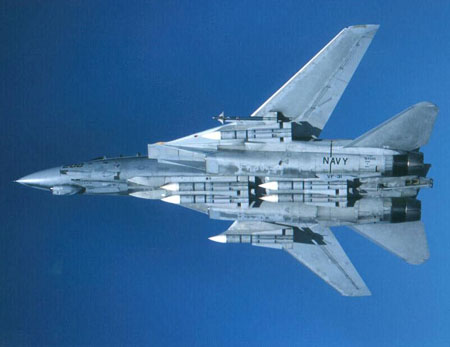

Primary Function: Carrier-based multi-role strike fighter
Contractor: Grumman
Crew: Two (pilot and radar intercept officer)
Unit Cost: $38 million
Powerplant
F-14A: Twin Pratt & Whitney TF30-P-41A turbofan engines (20,900 pounds of thrust w/ afterburner)
F-14B/D: Twin General Electric F110-GE-400 turbofan engines (29,080-high/27,948 average pounds each
w/ maximum afterburner)
Dimensions
Length: 61 feet 9 inches (18.6 meters)
Wingspan: 64 feet (19 meters) unswept, 38 feet (11.4 meters) swept
Height: 16 feet (4.8 meters)
Weights
Empty: 41,780 lb (18951 kg) -- F-14D
Maximum Takeoff: 72,900 pounds (32,805 kg)
Performance
Speed: 2.34 Mach (1.2 Mach sea level)
Ceiling: 56,000+ feet
Range: Deck launched intercept F-14A - 915 nautical miles radius with two 280-gallon drop tanks jettisoned when empty - Deck launched intercept F-14D - 656 nautical miles radius combat range with two 280-gallon drop tanks
F-14D - With two 280-gallon drop tanks retained, 1,591 nautical miles ferry range
Armament - Up to 13,000 pounds of:
Air-to-Air Missiles (up to)
6 AIM-7 Sparrows
4 AIM-9 Sidewinder
6 AIM-54 Phoenix
Air-to-Ground Ordnance
MK-82 (500 lbs.)
4 MK-83 (1,000 lbs.)
4 MK-84 (2,000 lbs.)
MK-20 cluster bomb
4 GBU-10 LGB
GBU-12 MK-82 LGB
4 GBU-16 MK-83 LGB
4 GBU-24 MK-84 LGB
one MK-61A1 Vulcan 20mm cannon
The F-14 entered the fleet in 1973, replacing the F-4 Phantom II. The F-14B, introduced in November 1987, incorporated new General Electric F-110 engines. In 1995, an upgrade program was initiated to incorporate new digital avionics and weapon system improvements to strengthen its multi-mission competitive edge. The F-14D, delivered in 1990, was a major upgrade with F-110 engines, new APG-71 radar system, Airborne Self Protection Jammer (ASPJ), Joint Tactical Information Distribution System (JTIDS) and Infrared Search and Track (IRST). Additionally, all F-14 variants were given precision strike capability using the LANTIRN targeting system, night vision compatibility, new defensive countermeasures systems and a new digital flight control system.
Primary Function: Carrier-based multi-role strike fighter
Contractor: Grumman
Crew: Two (pilot and radar intercept officer)
Unit Cost: $38 million
Powerplant
F-14A: Twin Pratt & Whitney TF30-P-41A turbofan engines (20,900 pounds of thrust w/ afterburner)
F-14B/D: Twin General Electric F110-GE-400 turbofan engines (29,080-high/27,948 average pounds each
w/ maximum afterburner)
Dimensions
Length: 61 feet 9 inches (18.6 meters)
Wingspan: 64 feet (19 meters) unswept, 38 feet (11.4 meters) swept
Height: 16 feet (4.8 meters)
Weights
Empty: 41,780 lb (18951 kg) -- F-14D
Maximum Takeoff: 72,900 pounds (32,805 kg)
Performance
Speed: 2.34 Mach (1.2 Mach sea level)
Ceiling: 56,000+ feet
Range: Deck launched intercept F-14A - 915 nautical miles radius with two 280-gallon drop tanks jettisoned when empty - Deck launched intercept F-14D - 656 nautical miles radius combat range with two 280-gallon drop tanks
F-14D - With two 280-gallon drop tanks retained, 1,591 nautical miles ferry range
Armament - Up to 13,000 pounds of:
Air-to-Air Missiles (up to)
6 AIM-7 Sparrows
4 AIM-9 Sidewinder
6 AIM-54 Phoenix
Air-to-Ground Ordnance
MK-82 (500 lbs.)
4 MK-83 (1,000 lbs.)
4 MK-84 (2,000 lbs.)
MK-20 cluster bomb
4 GBU-10 LGB
GBU-12 MK-82 LGB
4 GBU-16 MK-83 LGB
4 GBU-24 MK-84 LGB
one MK-61A1 Vulcan 20mm cannon
David
http://ultimatewarbirdflights.com/
Get 'NX611' back in the air http://www.lincsaviation.co.uk/news/lancaster-nx611-return-to-flight/
http://ultimatewarbirdflights.com/
Get 'NX611' back in the air http://www.lincsaviation.co.uk/news/lancaster-nx611-return-to-flight/
-
Spitfire - Boeing 747
- Posts: 5207
- Joined: Wed Dec 10, 2008 11:06 am
- Location: Hayle, SW Cornwall
Re: Aviation Orientated Countdown...
by Mayfly » Mon Mar 30, 2009 3:23 pm
fabulous music.....thank you spitfire
Last edited by Mayfly on Tue Mar 31, 2009 2:16 pm, edited 1 time in total.
In memory of a very dear friend - Mike Pearson
Very fond memories of Robbie Gilvary - DTs 1st Vulcan Captain who taught DT all he knew.
Very fond memories of Robbie Gilvary - DTs 1st Vulcan Captain who taught DT all he knew.
-
Mayfly - Moderator
- Posts: 29760
- Joined: Mon Sep 29, 2008 7:11 pm
- Location: Bomber County
Who is online
Users browsing this forum: No registered users and 12 guests


Content & Design © WedgySoft
Powered by phpBB® Forum Software © phpBB Group
Glacier v3.0.4 - Design by Ika © 2009 ShadowFlames Development - Modified & Upgraded to v3.0.14 by WedgySoft
85,313,029 Views
Time : 0.754s | 16 Queries | GZIP : Off
Powered by phpBB® Forum Software © phpBB Group
Glacier v3.0.4 - Design by Ika © 2009 ShadowFlames Development - Modified & Upgraded to v3.0.14 by WedgySoft
85,313,029 Views
Time : 0.754s | 16 Queries | GZIP : Off